Algunos restaurantes recomendados en nueva york
Cafe Loup: Un restaurante en mi antiguo barrio a donde iba a menudo. Muy tranquilo con muy buena onda, la comida francesa no esta mal. Te dan mucho y viene con mucha verdura (menos la hamburguesa). Dos pueden cenar bien tomando sopa ycompartiendo un rack of lamb. Buen brunch con jazz los domingos. Precio medio. 13th st & 6th ave
Sobaya: japones que se especializa en platos que contienen soba (un tipode fideo). Todo muy fresco y bien hecho. Muchos japoneses comen aqui. No toman reservas, muchas veces hay que esperar. El de sushi que esta en frente,un poco al oeste, no esta mal de alternativa. barato-medio. E9 st between 2& 3 ave
Teresa: Restaurante humilde polaco. Puedes ponerte al tope por poco dinero. Comida sana, pero un poco pesada, del estilo antiguo. Buena sopa, y casi todo muy rico, digo yo. Barato. 1st Ave between 4th & 5th st.
Veselka (2nd ave and 9th st) parecido, pero Teresa es mejor.
Paladar: pan-latino. Mojitos primero,despues comida. Divertido con un grupo. barato-medio 161 Ludlow St between Houston & Stanton (lower east side)
Katz's Deli: Tienes que probar un sandwich de pastrami aqui si no lo has hecho todavia. Pastrami es un fiambre elaborado con carne y especias que es como el jamon de pata negra de mis abuelos. Pero los que saben prepararlo son muy pocos (hay mucho pastrami mal, pero no tiene nada que ver). Es obligatorio tomar el pastrami en un sandwich con "rye bread" y mostaza ("pastrami on rye with mustard"). Tiene algo de sal y grasa, no es para tomar todos los dias, aunque quieras. barato (205 E Houston and Ludlow)
Gennaro's: Muy buena comida italiana bastante economica para NYC. Pero no se puede reservar, y a veces hay que esperar. barato-medio (pero los"specials" que te recitan cuestan mucho mas que los platos de la carta). 665 Amsterdam between 92 & 93 (Upper West side)
Zarela's: Es un mexicano tipo "gourmet" en el East Side. Hay mucha movida donde el bar, pero las mesas arriba estan mas tranquilas. Buena comida. Precio medio 953 2nd between 53rd & 54th St (Upper East Side)
Artisanal: Tiene una larga lista de quesos de varias partes del mundo (varios españoles incluso). Tiene un plato que es una tabla de quesos junto con frutos y embutidos que va muy bien con vino. Tiene una carta completa francesa tambien, pero un poco caro. Precio medio (depende de lo que pides). 32nd St between Madison & Park
Lavagna: Buen Italiano con encanto. E 5th St between Ave A & B. Precio medio.
Minca: Ramen Japones (sopa de fideos). Misma manazana que Lavagna. Barato.
Mirabelle: Frances "del barrio". Buena comida, clientes mayores. Precio medio. W86 St & Columbus Ave (near Central Park).
Gene's: Italiano del barrio. Precio medio. W11 St, near 6th Ave.
Murray's Bagels: Desayuno, almuerzo. Prueba un bagel con whitefish salad, o con"nova" (salmon ahumado) y cream cheese. O un bagel con cream cheese para ponerte al tope por casi nada. Barato. 6th Ave between W12 & 13th. Hay otro en Chelsea, 8th Ave
Showing posts with label food. Show all posts
Showing posts with label food. Show all posts
Sunday, November 02, 2008

Saturday, May 10, 2008
Totally OT: Spanish Fish
I wrote this for a vegetarian who was visiting Madrid:
Spanish fish
In general, restaurants in Madrid serve very fresh fish. Galician (“gallego”) restaurants are usually a good choice for all kinds of seafood, as are Basque (“Vasco”) and Asturian restaurants.
Besugo: Bream
Dorada: Golden bream(?)
Lubina: Bass
These fish are all highly appreciated and are usually caught locally and served whole. Often served “a la espalda” (baked and then drizzled with garlic and oil) or “a la sal” (The fish is completely encased in rock salt and roasted. The salt is then broken open, and if it is done properly the fish does not taste salty at all, but is very tender and moist.)

Besugo
Trucha: trout
Always good, and often the cheapest dish on the menu. “Trucha a la Navarra” is pan-fried with a piece of bacon or ham inside.
Boquerones: fresh anchovies (not salty like canned anchovies)
Boquerones al vinagre are pickled in brine (called “white anchovies” in places like Zabar’s). Often served as inexpensive tapas in bars. Boquerones fritos are very delicious, a good choice at low end restaurants and a favorite among children.
Sardinas: fresh sardines, bigger than boquerones, served fritas or asadas (grilled). Inexpensive and healthy, often eaten with the hands.
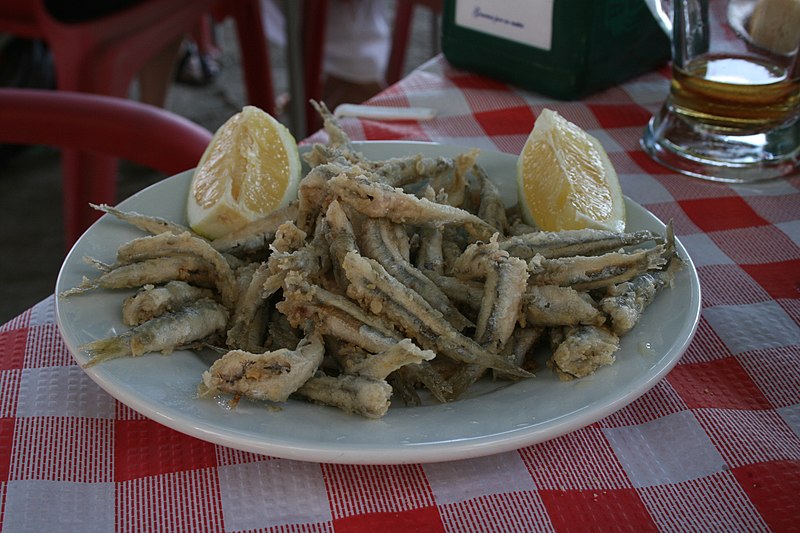
boquerones fritos
Merluza: hake (like cod, but a bit firmer).
This may be the most common fish in Spain, usually served in “steaks”. “Merluza a la gallega” baked in a casserole with potatoes, is my favorite.
Lenguado: sole
Rodaballo: flounder(?)
Mero: grouper
Pescado en adobo, cazon en adobo, et al: Small chunks of fish, marinated in lemon juice and other seasonings, then breaded and fried. This is a specialty in the south, where it is always good. In Madrid, it’s more hit or miss (like getting soul food in New York). Good at La Giralda, not bad at La Trucha off Plaza Santa Ana.
There are several words for squid:
Calamares: deep fried rings of squid (what you’re used to)
Chopitos: tiny little baby squid, usually fried
Chipirones: small-medium squid, sometimes served whole “a la plancha” (cooked on hot metal—basically on a griddle with a little oil).
Gambas, gambones, camarrones, langostinos (there are some other words as well): shrimp. Usually served with the shells on, even in paella; peel them with your hands.
Pulpo: Octopus. Pulpo a la gallega=pulpo a la feira. A classic dish from Galicia, boiled octopus, cut in slices and drizzled with olive oil, pimenton (paprika) and salt. Makes a great snack with a glass of white wine or beer.

pulpo a la gallega / pulpo a la feira
Emperador=pez espada=swordfish
Usually served “a la plancha” sliced much thinner than in the US, and cooked quickly.
Percebes: goose barnacles. These come from Galicia and are considered a great delicacy. You should try them if you get a chance, because you won’t get anything like them in the US.
Almejas: clams
Mejillones: mussels
Vieiras: scallops, usually served in the shell.
Ostras: oysters. They exist, but are not so common
There are a million different kinds of shellfish; I only know some of them.

cigalas -- don't miss this (if you can afford it)
Vegetables, etc.
The usual word for vegetable is “verdura”.
Ensalada mixta: standard lettuce & tomato salad, usually contains some canned tuna, olives, asparragus, etc.
Acelgas: Swiss chard, this is one of the most common green vegetable. Usually served“rehogadas”, which means sauteed with garlic and oil.
Pimientos de padron: A galician specialty, these are small green peppers, served roasted; about every tenth one is spicy, the rest are mild.
Gazpacho is usually very good, but most restaurants stop serving it when the weather gets cold. Salmorejo is a thick Andalusian version of gazpacho, topped with a little hard boiled egg and chopped serrano ham.
 salmorejo cordobés
Judias verdes=green beans.
Some restaurants have a “parrillada de verduras”, which is a plate of mixed grilled vegetables, good for sharing.
Lentejas: lentil soup. Very typical everyday food. Almost always contains some pork product like chorizo. Usually very good if you can get past the meat.
Beans are often called judias, judiones, alubias, habas, fabes. Never frijoles or habichuelas—these are Latin American terms. Most bean dishes contain some meat products—usually pork. If you can tolerate it, they tend to be very good. My favorite is fabada asturiana—made with white beans. Another Asturian specialty is fabes con almejas: white beans with clams. Judiones de la granja is a Segovian specialty made with very large white beans. Spanish bean dishes are usually not served with rice.
 fabada asturiana
Plátano simply means banana.
Every restaurant will have some fresh fruit or yogurt for dessert. Other common choices are flan, natillas (custard), crema catalana (crème brulee), arroz con leche (rice pudding), tarta de queso (cheese cake), tarta de zanahoria (carrot cake).
Tortilla=omelette (they don’t even know what a Mexican tortilla is). Tortilla de patata is ubiquitous—very filling and delicious, good with beer, wine or coffee. In almost any bar or cafeteria you can get a “pincho de tortilla” which is a small portion of potato omelette with a piece of bread—a stand by for many vegetarians.
 pincho de tortilla
In any cafeteria you can get:
Café con leche, café solo (expresso), café cortado (expresso with a dash of milk), té, manzanilla (chamomile), menta poleo (spearmint tea), una caña (a small draft beer), una copa de vino tinto, una copa de vino blanco, un agua mineral con o sin gas, una coca cola, una fanta de naranja o limon, un zumo de naranja, etc.
Subscribe to:
Posts (Atom)


